
A company can pass its AGM resolutions and still leave the meeting with a shareholder problem
At the IR Impact Think Tank – Europe 2026, Maria Siano, general manager, corporate governance data and insights at Broadridge Financial Solutions, described a current challenge to IROs as activism becoming ‘broader, more sophisticated’ and ‘less visible at the onset’. She also warned that ‘shareholder pressure begins much more quietly’ than many companies may expect.
Siano described the voting data as showing shareholder pressure that is ‘active’ but ‘concentrated.’ Most resolutions at UK and European general meetings still pass comfortably, she noted, but some are drawing material dissent.
Her comments were based on Broadridge’s analysis of roughly 320 resolutions across more than 70 general meetings in larger UK and European markets during the past three years. Some resolutions drew more than 40 percent opposition, which Siano called ‘severe shareholder disagreement.’ Others exceeded 75 percent opposition, which she described as ‘extreme dissent.’

New pressure points
The pressure points were familiar: remuneration, board accountability, capital structure and amendments to articles of association. But Siano noted that a company can have an AGM that ‘overall looks successful’ while still needing ‘serious follow-up’ on one or two resolutions.
‘If you only ask the question Did the resolution pass? you might miss the more important view,’ she said. The more important issue is where support has weakened, who drove the opposition and what it may say about future risk, she added.
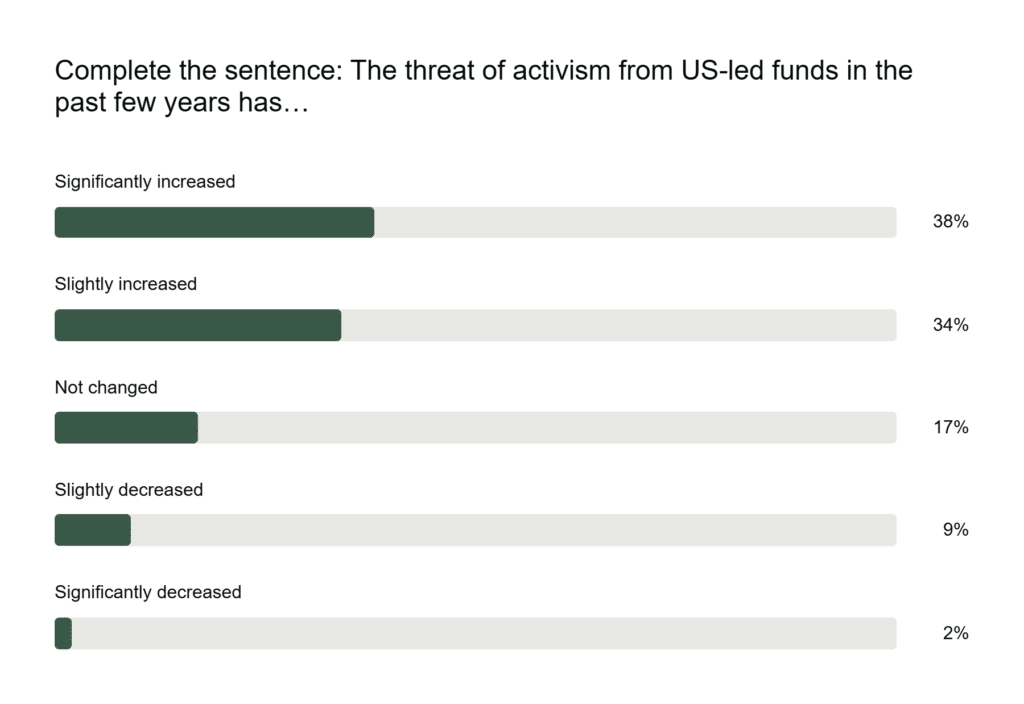
The discussion also covered the role of US-led funds in UK and European activism. Audience polling showed attendees viewed that threat as rising: more than seven in 10 said the threat from US-led funds had increased in the past few years, with 38 percent saying it had increased significantly and 34 percent saying it had increased slightly. Only 28 percent said it had not changed or had decreased.
Siano explained that the risk lies not only in the presence of a US-led activist, but in whether its argument finds support among other shareholders. Pressure builds when an activist’s argument can ‘resonate with the mainstream investors’ and is ‘already present in the shareholder base,’ she said.
That is where quiet dissent becomes more serious: an activist can amplify concerns shareholders may already hold, even if those issues have not yet turned into public opposition.
Siano pointed to valuation, capital allocation, portfolio structure and margin performance as areas where activists may build a case. Governance is another route in, particularly around board accountability, capital discipline and the link between governance and value creation.
She added that US activists are not ‘just importing the US playbook’, but ‘adapting the argument to local governance and local shareholder expectation.’
Sharing activist tactics
The event’s audience were asked to share their own experiences of activism. One who had dealt with US activists described them as ‘extremely well prepared.’ The participant warned against a defensive reaction, but also said companies should not give activists disproportionate weight: ‘Treat them the same as everybody else.’
Another attendee described a previous role at a chemicals company where a large US asset manager not typically viewed as an activist became frustrated after management failed to listen. ‘Even if they are not activists, it can absolutely snowball,’ they said.
Audience polling also pointed to the practical challenge, with attendees naming time, preparedness and the risk of being blindsided among their main concerns around shareholder activism.
Siano told attendees to focus on ‘signals that show the concern before it becomes public’. One is recurring or rising dissent: if opposition to a resolution increases year on year, even while the resolution passes, the company should pay attention, she said.
A second signal is ‘policy-sensitive resolutions’, such as remuneration or board elections, where a proposal may trigger a shareholder’s formal voting policy. If that happens, ‘the support is going to decrease very quickly,’ Siano explained.
She also pointed to ‘the gap between the company explanation and investor perspective.’ Companies may have ‘a rational explanation for a decision,’ she noted, but shareholders need to understand how that decision supports long-term value creation.
Unresolved engagement feedback is another warning sign. If one shareholder or several shareholders raise a similar issue during the year, ‘that should be treated seriously,’ Siano said. The final signal is when those issues line up with an activist’s argument. In those circumstances, she added, ‘the activist can organize, amplify and make it more public.’
Early and targeted engagement
Siano said companies should engage early, not just around the AGM, because shareholders ‘may already form their view’ by that point. She also emphasized the need to prioritize: ‘Different investors have a different view across certain themes,’ she said.
Data and technology can help companies move from broad shareholder engagement to ‘more data-led engagement’, Siano explained. The aim is to identify which shareholders matter most on a specific issue, what is likely to drive their vote and where engagement can influence the outcome.
Messaging also needs to reflect the audience. Portfolio managers may focus on valuation, strategy and performance, while stewardship teams may look at policy alignment, governance and board accountability. The message should remain consistent, Siano noted, but the emphasis may need to vary by the audience.
What does this mean for IR?
Investor relations teams can tackle quiet dissent by identifying shareholder concerns before they become public and explaining governance decisions clearly, with the emphasis tailored to each audience.
Other takeaways include:
- Recurring dissent, policy-sensitive resolutions, unresolved feedback and gaps between company explanations and shareholder expectations should be escalated before pressure builds
- A passed resolution can still show weakened support, particularly on remuneration, board accountability, capital structure or governance changes
- Activists can amplify issues already present in the shareholder base, especially when their argument resonates with mainstream shareholders
- Data can help companies prioritize which shareholders to engage with, understand their concerns and tailor governance messaging.
As Siano put it, the companies best placed to navigate this environment will be those that combine the data, engage early, have a concise strategy and explain how governance and board decisions support value for shareholders.